The problem of
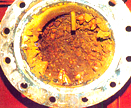
fouling is all too familiar to operators of seawater
systems on ships, rigs, oil platforms, power stations
and elsewhere. Marine growth, such as mollusca,
barnacles, mussels, algae and slime enter the
seawater system and find a spot where temperature,
nutrients, PH factor and other environmental conditions
are right for settling and breeding. If this settling
is not prevented colonies quickly develop resulting
in problems such as turbulence, blocked pipes
and impaired heat transfer efficiency. Such partially
or fully blocked pipes can also lead to dangerous
situations, particularly with fire-fighting equipment.
What is worse is, cleaning of such blocked pipes
or in many cases replacement of complete sections
of the pipeline can be an extremely time consuming
and expensive problem.
But luckily it is a problem that can be easily
overcome by the use of Cuproban Electrolytic anti-fouling
and corrosion control systems. |
The system
consists of Copper and Aluminium (or soft iron)
anodes strategically located in sea chests or
sometimes in-board, but as close to the sea water
intake point as possible. One such set of anodes
is recommended for each sea water service. The
anodes are connected to a control panel that feeds
a current to the anodes. The resultant ions and
'floc' produced by the anodes is carried by the
sea water, spreads through the pipe work and creates
an environment that is distinctly unfriendly to
the marine life. Thus any marine life larvae that
enter the pipe line will not settle but will pass
right through to discharge. An added benefit is
that the Aluminium hydroxide 'floc' creates a
protective film on the pipelines thereby significantly
reducing pipeline corrosion.
The result
- Cleaner pipelines with much longer and trouble
free life resulting in lower maintenance and running
costs!
|